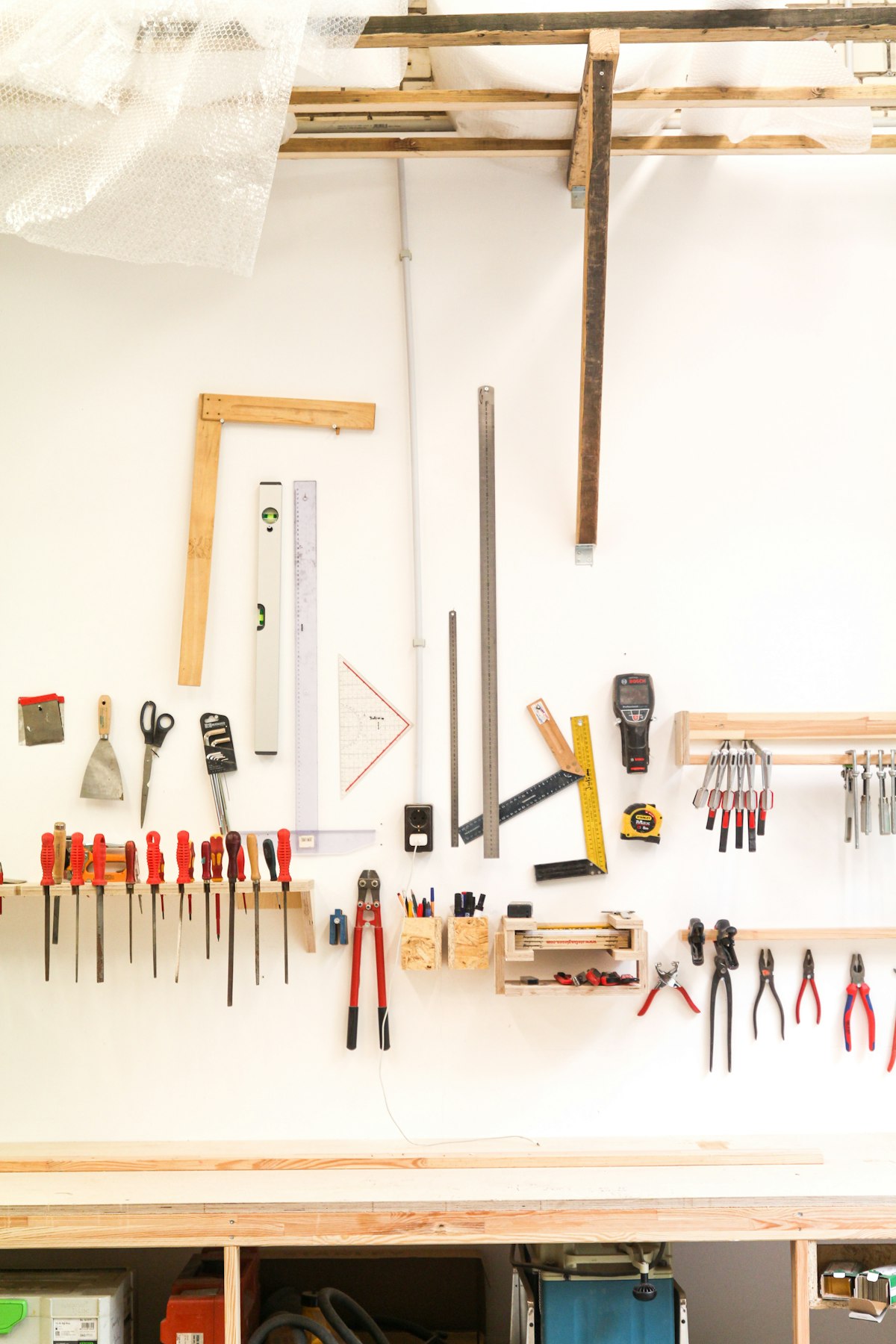
Installing Skadi takes around 15 minutes. If you can drill two holes and tighten four screws, you can install it.
Installing Skadi takes around 15 minutes. If you can drill two holes and tighten four screws, you can install it.
This guide covers where to mount it, how to fix it to the wall, how to set the correct height, and how to use it safely from the first time you pick up a piece of wood.
Key Takeaways
→ Mount at approximately 1.2 metres from the ground (top screws) — standing working height
→ Fix to a solid wall (brick, stone, blockwork) or a sturdy wooden post
→ SDS or masonry drill bit required for wall installation; wood bit for post installation
→ The safety pin locks the blade when not in use — always replace it after use
→ Heavy-duty gloves are strongly recommended throughout
What's in the Box
When your Skadi arrives, the box contains:
Skadi The Kindling Splitter
Safety pin
Mounting hardware (screws and wall plugs)
You'll need to supply a drill, a masonry or wood bit (depending on your surface), a screwdriver or socket set, and a spirit level if you want to check alignment.
Step 1: Choose the Right Location
Before drilling anything, choose where to mount Skadi.
Wall requirements: A solid wall — brick, stone, or blockwork. Timber stud walls can work with appropriate fixings into the studs, but solid masonry is the most secure option. Plasterboard alone is not suitable.
Post option: Skadi can also be mounted on a sturdy wooden post — a fence post, a timber upright in a shed or garage, or a dedicated post set in concrete. The post should be at least 100 mm × 100 mm and firmly fixed.
Location considerations:
Choose somewhere you can stand comfortably and work without restriction
Leave clear space in front and below the blade — you'll be pressing wood downward and outward
A garage, garden wall, shed, or utility area are all typical locations
The area below will collect wood chips and bark — somewhere easy to sweep is practical
Step 2: Mark the Fixing Height
The correct mounting height for Skadi is approximately 1.2 metres from the ground to the top screws.
This positions the blade at a comfortable working height when you're standing upright. Too low and you'll be bent over; too high and you lose leverage.
To mark the height:
Measure 1.2 metres up from the floor and mark with a pencil
Hold Skadi against the wall with the top fixings at this mark
Use a spirit level to confirm it's vertical (or close to it)
Mark the fixing hole positions through the mounting plate
Step 3: Drill and Fix
For a masonry wall:
Use a masonry drill bit (SDS preferred for harder materials, standard rotary for softer brick)
Drill to the depth required for the wall plugs included
Insert the wall plugs
Hold Skadi in position and fix with the screws provided
Tighten firmly — Skadi takes reasonable force during use and needs to be solid
For a wooden post:
Use a wood drill bit slightly smaller than the screw diameter to create a pilot hole
Screw directly into the post — no wall plugs required
Ensure the screws seat fully into the wood
Give the mounted unit a firm push and pull to confirm it doesn't move. If there's any flex, check the fixing depth and tighten accordingly.
Step 4: Test Before First Use
Before splitting any wood, confirm:
Skadi is firmly fixed to the wall with no movement
The blade moves freely without obstruction
The safety pin goes in and out smoothly
You have clear space below and in front of the blade
Put the safety pin in and step back. It should feel solid and stable.
How to Use Skadi
Once installed, the process is the same every time:
Put on heavy-duty gloves — strongly recommended throughout
Remove the safety pin — keep it nearby while you work
Select your wood — start with pieces under 10 cm diameter and no longer than 45 cm
Place the wood on a lower notch — lower notches are for starting the split; use them to get the blade into the wood from a corner or edge
Press the blade in — use steady, controlled pressure; push from the corners or edges of the piece, not the centre of a large flat face
Move to higher notches — as the split opens, slide the wood up to maintain leverage and complete the split
Remove the finished pieces — set them aside
Replace the safety pin when you've finished
Which Wood Works Best
Skadi handles both softwood and hardwood. The technique varies slightly:
Softwood (pine, spruce, larch, pallet wood): Splits with minimal effort. Press from any corner or edge and the wood parts cleanly. Ideal for quick kindling production.
Hardwood (oak, ash, walnut, birch): Takes more effort and patience. Always start from the outer edges and work inward in smaller increments. Don't try to split a dense hardwood piece from the flat face — start at the edge and let the wood guide the split.
Maximum dimensions: 10 cm diameter, 45 cm length. Pieces larger than this won't fit between the blade and the notches effectively.
Maintenance and Care
Skadi requires minimal maintenance:
Blade sharpness: The blade will dull slightly over time with heavy use. It can be resharpened with a metal file or taken to a tool sharpener.
Paint: The electrostatic paint finish may chip with regular use. This is normal and doesn't affect performance or the integrity of the steel.
Outdoor use: If Skadi is mounted in an exposed outdoor location, the blade and metal parts will develop a natural patina rust coating over time. This is surface oxidation that permanently protects the underlying metal — it's a feature, not a fault.
Cleaning: Wipe down with a dry cloth as needed. No oiling required.
Safety Reminders
Always replace the safety pin when Skadi is not in use
Always wear heavy-duty gloves when splitting
Keep children clear of the blade area during use
Inspect fixings periodically — particularly if mounted outdoors — to ensure they remain tight
Never try to split oversized pieces: if a piece won't fit on the notches comfortably, cut it down first
Conclusion
Skadi installs in under 15 minutes and is ready to use immediately. Mount it on a solid wall at 1.2 metres, fix it firmly, and it'll be in the same spot doing the same reliable job for years.
Skadi can be mounted on any solid masonry wall (brick, stone, blockwork) or a sturdy wooden post. It is not suitable for plasterboard or lightweight partition walls without fixing into the structural studs behind.
How high should I mount Skadi?
Mount with the top fixing screws at approximately 1.2 metres from the ground. This positions the blade at a comfortable standing working height for most adults.
Does Skadi come with fixing hardware?
Yes — screws and wall plugs are included in the box. You'll need a drill, a masonry or wood bit appropriate for your surface, and a screwdriver.
Can I mount Skadi outdoors?
Yes. Skadi can be mounted outdoors on a suitable wall or post. In exposed conditions, the painted finish may weather and the metal will develop a natural patina rust coating — this is a protective oxide layer that doesn't affect performance.
How long does installation take?
Most people install Skadi in 10–20 minutes. If you've drilled into masonry before, it's a straightforward job.
What if my wall is very hard (engineering brick, granite)?
Use an SDS drill with an appropriate masonry bit. Take your time on harder materials and don't force the drill — let the tool do the work.
Setuphow to install wall mounted kindling splitter